
I am a rose of Sharon … Song of Solomon 2: 1

The Sharon Tulip: Possible “Rose of Sharon” Israel [i]
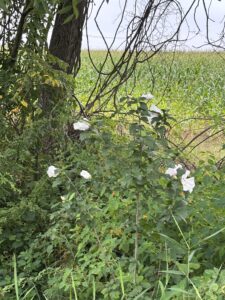
Rose of Sharon Bush in a ditch
On my morning walk I see a lot of odd things. The picture above of a domestic flower growing in a roadside ditch stood out as strange. The bush is a common landscape item around homes, so seeing this flower blooming in the ditch, surrounded by wildflowers, poison ivy, walnut trees, and a corn field brought to mind the verse in Solomon (above). In the original text, Rose of Sharon referred to the writer’s beloved. In some gospel songs Jesus is referred to as the “Rose of Sharon.” Indeed, our Lord Jesus may be thought of as an object of exquisite beauty and fragrance; however, the metaphor in Song of Solomon might better describe Christ’s beloved, the Church.
What we commonly call Rose of Sharon is not native to Israel, nor is the flower found in the Plain of Sharon in central Israel. The common Rose of Sharon is the Hibiscus syriacus, [ii] a native, rather, to areas of east Asia and commonly found throughout Europe and North America. A possible “flower from the Plain of Sharon may have been the Sharon Tulip (pictured above).
In my own experience in what we know as Rose of Sharon, I learned the bush can be invasive. When we leased out our Christmas tree farm to a tree grower, he removed all of the Rose of Sharon we had planted along the lane near the field of trees. He explained that the bush would pop up from seed among the trees, take root and destroy the trees. The Rose of Sharon in the roadside ditch is a case in point.
By this time, you may wonder why I am writing this and what it has to do with the Christian life. I do have a point. When Jesus gave His last instructions…
“You will receive power when the Holy Spirit has come upon you, and you will be my witnesses in Jerusalem and in all Judea and Samaria, and to the end of the earth.” Acts 1: 8
… He expected them to scatter everywhere, like a lovely, but invasive, flowering bush, even in the ditches of society, to bring the Gospel—the Good News—that He took our place of death for sin.
So, how are we doing? Eight and a quarter billion people live in our world, with more than 16,000 people groups in the world, and more than 7,000 languages, only half of these language have the Bible in print. But less than a third of the world even calls themselves Christian, and less than ten percent are evangelical. An estimate of nearly thirty percent of the world’s population have never even heard the Gospel of Jesus Christ. (See the map below where billions of people live who haven’t heard—some of them next door.)
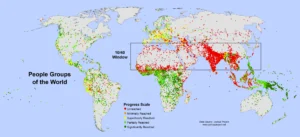 [iii]
[iii]Totally unreached people groups in red
You say, “I’m only one person. Evangelizing is too overwhelming.” You ask, “What can I do?” Indeed, what can we do? There are many organizations serving around the world. I’d encourage you to read up on the need and what is being done. (See list below.)
Everyone who calls on the name of the Lord will be saved. How then will they call on him in whom they have not believed? And how are they to believe in him of whom they have never heard? And how are they to hear without someone preaching? And how are they to preach unless they are sent? Romans 10: 13-15
As an individual, here are a few ways you can reach the neighborhood, the field, the ditch, or around the world:
- Pray for people you may see in your day-to-day life who may never have been exposed to the Gospel message, asking God to give you the opportunity to tell them about Jesus.
- Learn what you can about the unreached people throughout the world.
- Get involved in your church’s missionary program, learning about the work and the area where they minister. Correspond with the missionaries.
- Engage with people from different cultures in your community, by visiting ethnic restaurants, volunteer to host international students.
- Stop and talk to a homeless person and share the Gospel; or volunteer at a homeless shelter or a pregnancy center.
- Consider a career in missions. If a career in Christian service is not possible, consider a short-term mission trip.
- If you cannot go, be a part of the sending by setting aside funds to spread the Gospel.
- Contribute to a Bible-sending organization.
- Contribute to Bible translation into languages where there is no Scriptures in their tongue.
- Ask someone from a foreign country to teach you to speak their language and use the opportunity to share the Gospel.
In 2023 legal immigration to the USA brought 1,169,140 people to our country. Another estimated 3 million slipped across our borders the same year. Each year they continue to come within reach of our opportunity to share the Gospel. Many come from countries where to share the Gospel openly would be a death sentence. Their arrival here may, indeed, be the means God has provided for being His witnesses “to the end of the earth.”
Be a bloom in whatever yard or ditch God has placed you.
Perhaps someone has been a “bloom” in your life, and you have heard the Gospel many times, but you have never trusted Jesus as your Savior.
Behold, now is the favorable time; behold, now is the day of salvation.
2 Corinthians 6: 2
Challenge:
We are all commissioned by the Lord Jesus to bloom where He plants us. Ask Him for guidance in how you are to bloom.
Prayer:
Lord Jesus, thank You for taking the punishment for our sins upon yourself; help us to share the Good News in whatever way and wherever you lead us. Open the ears of those we encounter to hear the Gospel and their hearts to respond. For Your sake, Amen.
Promise:
Everyone who calls on the name of the Lord will be saved. Romans 10: 13
Let me know how I can pray for you. June
Statistics — Global Commission
Just How Reached Is The World? – Jesus Film Project
Has Everyone Heard? | Joshua Project
How Many Countries Have Not Heard the Gospel?
[i] https://www.templesinairi.org/uploads/6/4/1/4/6414122/1771212.jpg?293
[ii] https://en.wikipedia.org/wiki/Rose_of_Sharon
[iii] https://images.squarespace-cdn.com/content/v1/5ecaa36ce7531e2750eca7b3/daf4f00e-14fe-4d92-9d0b-68f352e18624/progress-scale-map-1040.png?format=2500w
[iv] Creative commons